Rollers and hinges are the cheapest moving parts on a garage door and the most abused. A standard two-car sectional door has ten to thirteen rollers and a dozen or more hinges, and every one of them takes the full…
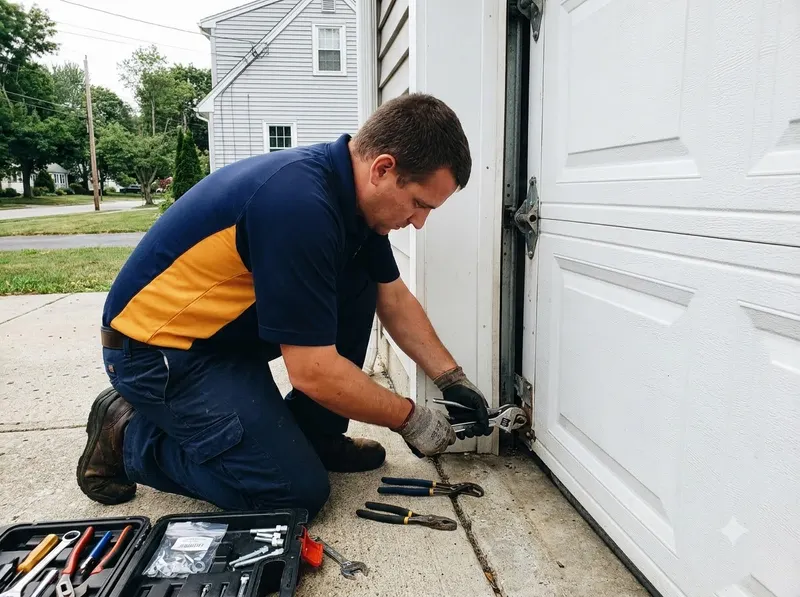
Rollers and hinges are the cheapest moving parts on a garage door and the most abused. A standard two-car sectional door has ten to thirteen rollers and a dozen or more hinges, and every one of them takes the full cycle count of the door — often 1,000+ open-and-close cycles a year on a busy Amherst household. When the nylon tire on a roller chips or the bearings dry out, the roller stops rolling and starts dragging. That drag is what makes the loud grinding you hear from inside the kitchen, and it is what slowly pulls hinges out of square until a panel edge sits proud of its neighbor. Replacing the hardware early keeps the load off the springs, the opener, and the tracks. Ignoring it is how a $300 hardware job turns into a bent track and a flattened top section.
Roller and hinge replacement fits when the door lifts but travels badly. Typical signs: a rhythmic thump or pop as the door rounds the horizontal curve, a roller stem visibly wobbling in its hinge sleeve, a hinge with a hairline crack radiating from the roller hole, a top-panel end hinge pulling loose so the door leans a few degrees, or steel rollers that have rusted solid and are now skidding instead of turning. If the door instead dropped with a bang and now won't lift at all, that is a broken torsion spring, not a roller. If the door reverses halfway back up on its own, look at photo eyes and limit settings first. If a cable has jumped its drum and one side sags, cable and drum work comes before hardware. We tell you which of those you actually have on the visit rather than selling hardware you don't need.
The trade-off worth knowing: you can replace only the damaged pieces, or refresh the whole set. Piecemeal is cheaper today and correct if two or three rollers are shot on an otherwise sound door. A full set makes more sense when the rollers are original steel, when the door is fifteen-plus years old, or when a landlord wants the door quiet and reliable through a tenant cycle. Nylon rollers with sealed 10-ball bearings run noticeably quieter than the steel rollers builders installed on many older Amherst doors — a real difference in attached garages under bedrooms, which is most of the split-levels around Amherst Woods and Orchard Valley. Steel rollers are tougher on heavy insulated doors and cost less; nylon wins on noise. We carry both and match the stem diameter and length to your existing hinges so nothing gets shimmed or forced.
Local conditions here chew hardware in specific ways. Sand and grit from winter road treatment on the Pelham Road hills and Route 116 gets tracked into the garage, then packs into open roller bearings and turns them into grinding paste by March. Gravel and unpaved drives around Cushman and North Amherst do the same year-round. Salt-laced slush accelerates rust on steel roller stems and on the fasteners holding end hinges, which is why bottom-section hinges are often the first to snap on doors near the Mill River and Bridge Street area. Older doors around Amherst Center and near the Emily Dickinson Museum frequently have thin-gauge original hinges that crack rather than bend. And in student rental blocks near the University of Massachusetts Amherst, Amherst College, and Hampshire College, doors get cycled hard and closed on obstructions — bent hinges and popped rollers are the most common thing we find during turnover inspections. We serve South Amherst, East Amherst, Echo Village, and the rest of Hampshire County with the same parts on the truck.
Every job gets a firm, written price after a free on-site visit.
Tell us about your roller and hinge replacement job in Amherst and we'll send a clear, written quote — usually the same day.
 Speed Spring GaragDoor's Repair